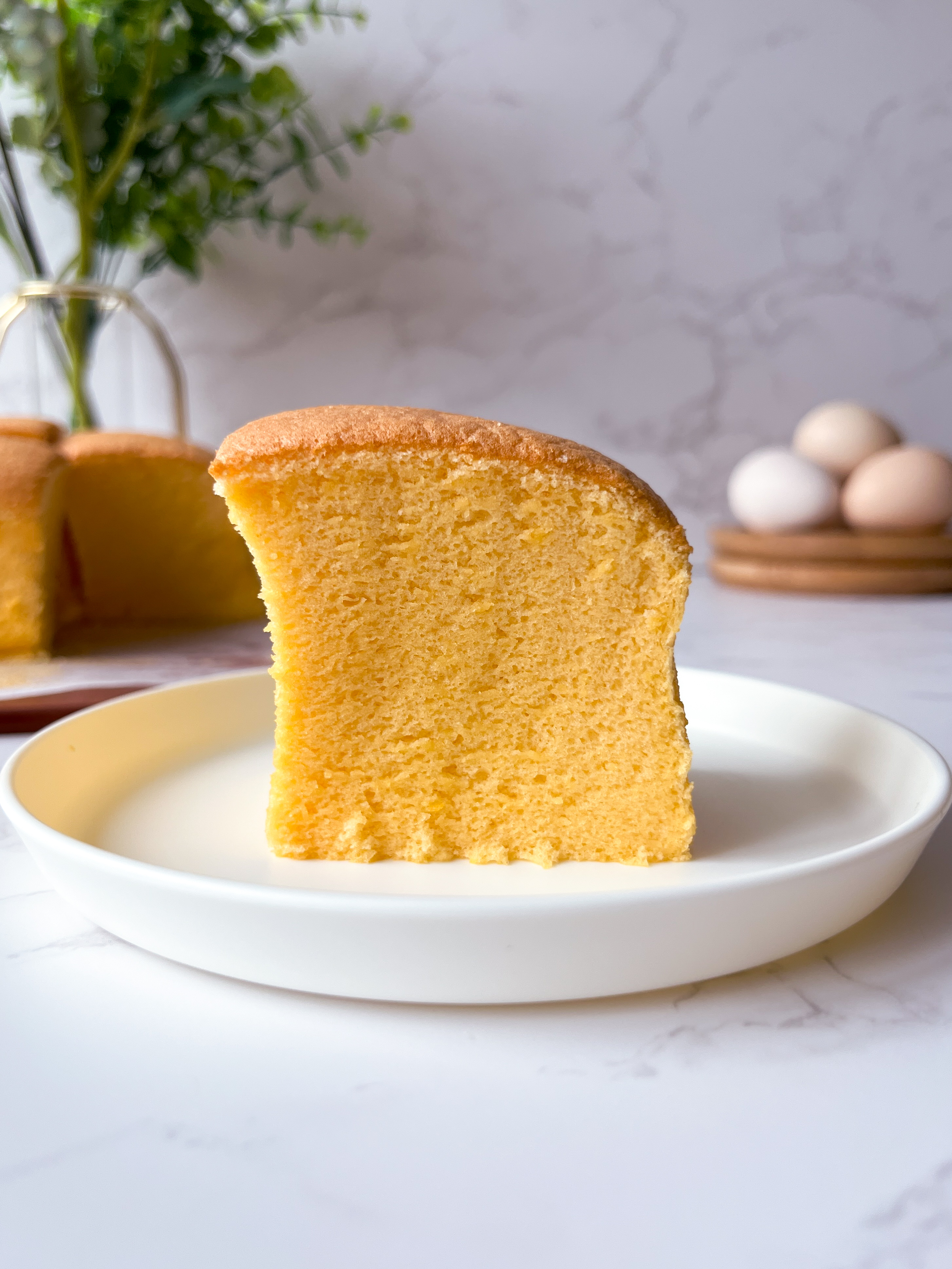
Whether you’re feeling down and in need of something sweet, or simply craving some desserts to satisfy your sweet tooth cravings, this Taiwanese castella cake is sure to please. It is pillowy soft and moist with a soufflé-like texture. As you bite into the cake, it melts in your mouth instantly and fills it with a rich eggy flavour, making it incredibly irresistible!
I’ve had multiple failed attempts at baking a castella cake at home where it shrank and deflated quickly after taking it out from the oven. Just some small mistakes will already affect the result of the cake, so be sure to continue reading this post to make a perfect castella cake at home!
Table of contents
- What is a Taiwanese castella cake?
- Ingredients for Taiwanese castella cake
- How to make Taiwanese castella cake
- How to make a perfect meringue for Taiwanese castella cake
- Success tips for making a perfectly jiggly and moist castella cake
- Why did the cake crack on top?
- Why did the cake have a dense bottom?
- Why did the cake collapse and deflate?
- How long does the cake last?
- More dessert recipes
What is a Taiwanese castella cake?
Taiwanese castella cake, or Taiwanese soufflé castella, is a jiggly cake with an incredibly soft and moist texture. It is basically a light, fluffy, and slightly sweetened sponge cake baked in a water bath, with a high proportion of eggs in the batter, resulting in a jiggly, soufflé-like texture.

Ingredients for Taiwanese castella cake
- Cake flour: Using cake flour will give you a lighter and more delicate sponge. If you don’t have cake flour, you can substitute with plain flour plus some additional cornstarch to achieve a light and fluffy texture.
- Oil: This contributes to the tenderness of the crumb, yielding a pillowy soft texture.
- Milk: Adding milk to the cake batter prevents the baked cake from becoming dry and crumbly, producing a soft and moist crumb.
- Eggs: Eggs are the most important ingredient in this recipe. The egg yolks add moisture and richness to the cake, while the egg whites (beaten) act as a leavening agent that allows the cake to rise to a fluffy and airy texture.
- Sugar: Sugar will be used mainly for making the meringue (beaten egg whites) to stabilise it after beating.
- Vanilla extract: This is optional but it will enhance the cake’s flavour with a touch of vanilla.
- Warm water: You’ll need to bake the cake in a hot water bath to provide a moist environment and radiate the heat in the oven, so that the cake can be baked evenly. Be sure to use warm/hot water but not boiling.
How to make Taiwanese castella cake
- Separate egg yolk and egg whites in two mixer bowls. Keep the egg whites chilled in the fridge.
- Heat the oil to 60-70°C in a pot, then pour it into a mixer bowl.


- Sift in cake flour, mix well.
- Stir in milk, add in egg yolks and vanilla extract, then mix until smooth.


- Prepare the meringue by beating the egg whites and adding in sugar 3 separate times. Beat until soft peaks (see below for detailed steps).
- Pour the egg yolk mixture into the meringue. Fold the batter until just combined.


- Preheat the oven to 150°C.
- Transfer the batter into a 18cm x 18cm square pan lined with parchment paper. I also wrapped the cake pan in aluminium foil to prevent water from getting in when baking in a water bath.
- Place the cake pan onto a baking tray, then pour in warm water.


- Bake in the water bath at 150°C in the oven for 60 minutes. For the last 10 minutes, occasionally open the oven-door to release some steam from the oven (see success tips below).
- Unmold the cake immediately after baking.

How to make a perfect meringue for Taiwanese castella cake
To make the perfect meringue, divide the sugar and add in 3 separate times while beating the egg whites. Begin with beating the egg whites on low speed using a hand mixer. When it forms a pale colour foam with large air bubbles, add in ⅓ of sugar.


As the egg whites become foamy like soap, increase the speed to medium-low. Beat until the egg white foam increases in volume with smaller air bubbles. Add in another ⅓ of sugar.


Continue beating on medium speed until you see a thickening, slightly glossy texture, then add in the remaining ⅓ of sugar. Beat gently on low speed to make a smoother meringue.


For Taiwanese castella cake making, you should beat the egg whites until soft peaks. When you pull out the whisk and turn it upside down, the tip should be flopping over. The meringue should be shiny and glossy with fine air bubbles. If this is the case, then the meringue is ready to be mixed into the batter!


Success tips for making a perfectly jiggly and moist castella cake
Beat the egg whites until soft/medium peaks.
Beating egg whites (the meringue) is the most important step in the process of making castella cake. It needs to trap a sufficient amount of air in order to rise high in the oven and achieve a light, airy, and fluffy texture. Be sure to beat the egg whites until soft peaks only. Overbeating will make the cake rise too quickly and expand rapidly in the oven, resulting in cracks on top and the cake to deflate and collapse afterwards.
Use chilled egg whites for the meringue.
As you beat the egg whites, you essentially whip the tight proteins to form a foam. By chilling egg whites before making the meringue, the cold temperatures help keep the proteins rigid, allowing you to create a more stable, and firmer meringue. You can also add in a dash of lemon juice or cream of tartar to the egg whites to strengthen the meringue.
Do not overmix or over-fold the batter.
Mixing and folding the batter until just right is key to ensuring the castella cake rises high and tall without collapsing. Be sure not to overmix or over-fold the batter, as this will lose most of the air that is required to make the cake rise. Otherwise, the cake will become dense and flat. On the other hand, undermixing will mean there’s not enough air incorporated into the batter, resulting in a cake that shrinks, collapses, and deflates after cooling down.
Bake the cake in a hot water bath, but not boiling.
A hot water bath creates a warm and moist environment for the cake to bake. It radiates the heat in the oven, and thus bakes the cake gradually and evenly. Be sure not to use boiling water as it will evaporate too quickly and bake the cake too fast, causing it to crack on top and resulting in a dry cake.

Why did the cake crack on top?
There are several possible reasons for the cake to crack on top
- You may have overbeaten the meringue. Overbeating the egg whites will cause the cake to rise too quickly in the oven while it is not fully baked, resulting in cracks on top.
- The water-bath is too hot – if the oven temperature is too high, this bakes the cake too quickly. Be sure to use warm/hot water but not boiling to achieve a smooth and cottony texture. When the cake has risen to a good size (for the last 10 minutes of the baking process), I usually open the oven-door occasionally for 5 seconds to release the steam and prevent the oven from getting too hot inside.
Why did the cake have a dense bottom?
This happens when the batter sets too slowly, causing the starch to separate and sink to the bottom of the cake pan where it hardens, resulting in a dense texture in the bottom layer.
Here’s how you could troubleshoot this problem:
- Be sure to use water that is hot enough for the water bath. Otherwise the bottom layer will form a dense layer as the batter slowly separates.
- Pour enough warm water to the baking tray (about 1-inch high). This ensures there’s enough moisture in the oven environment.
- Ensure the meringue is stable so that enough air is produced in the batter for the cake to rise.
Why did the cake collapse and deflate?
The beating of egg whites with sugar helps incorporate air into the batter and stabilise it to allow the cake to rise when baking. It is normal that the castella cake will deflate slightly as it cools down. It is the expanded hot air in the beaten egg whites that causes the cake to rise. But if your cake collapsed and deflated incredibly, this might be due to these reasons:
- You might have overmixed the batter. Overmixing will deflate the air produced in the meringue, resulting in a dense and flat cake.
- The meringue is not stable enough.
- The cake is underbaked.
How long does the cake last?
The castella cake will last for up to 2 days at room temperature or 4 days in the fridge. Be sure to let the castella cake completely cool down before storing in an airtight container.

This Taiwanese castella cake boasts a velvety texture and a subtle sweetness that will transport your taste buds to a realm of pure bliss. Offering a harmonious blend of eggy and vanilla flavours, I’m sure this will become your family-favourite cake as well!
More dessert recipes


I’d love to hear about your experience making my recipes! If you’ve tried this Jiggly and Moist Taiwanese Castella Cake recipe or any other recipe on HomeCookJournal, then don’t forget to rate the recipe and leave a comment below. Feel free to take snapshots of your experience with my recipes and share them on Instagram so I can repost on stories! And if you have any other foods you’d like to make, please feel free to comment as well!
Save this recipe!
Get this sent to your inbox, plus get updates on any new recipes!

Jiggly and Moist Taiwanese Castella Cake
Equipment
- 18cm x 18cm square cake pan
Ingredients
- 100 g cake flour
- 100 ml oil
- 80 ml milk
- 6 egg yolks
- 6 egg whites
- 1/2 tsp vanilla extract
- 80 g sugar
Instructions
Prepare the egg yolk mixture
- Separate egg whites and yolks. Keep the egg whites chilled in the fridge.
- Heat the oil to 60-70°C
- Transfer the oil into a mixer bowl, sift in flour, and mix well.
- Stir in milk, add in egg yolks and vanilla extract, and mix until smooth.
Make the meringue
- Begin beating the egg whites on low speed. When it forms a light colour foam with large air bubbles, add in 1/3 of sugar.
- Beat on low-medium speed. When the egg white foam increases in volume with smaller air bubbles, add another 1/3 of sugar.
- Continue beating on medium speed until you see a thickening texture, add in the remaining 1/3 of sugar.
- Beat gently on low speed to make a smoother meringue. Beat to soft peaks – when you pull out the whisk and turn it upside down, the tip should be flopping over.
Combine the meringue with the egg yolk mixture
- Preheat the oven to 150°C.
- Pour the egg yolk mixture into the meringue.
- Gently fold the batter until just combined.
- Pour the batter into a 18cm x 18cm square pan lined with parchment paper. I also wrapped the cake pan in aluminium foil as an insurance to keep the water from getting in.
- Place the cake pan onto a baking tray, then pour in warm water to about 1-inch height.
- Bake in water bath at 150°C in the oven for 60 minutes. For the last 10 minutes, open the oven occasionally to release some steam from the oven.
- Unmold the cake immediately after baking.