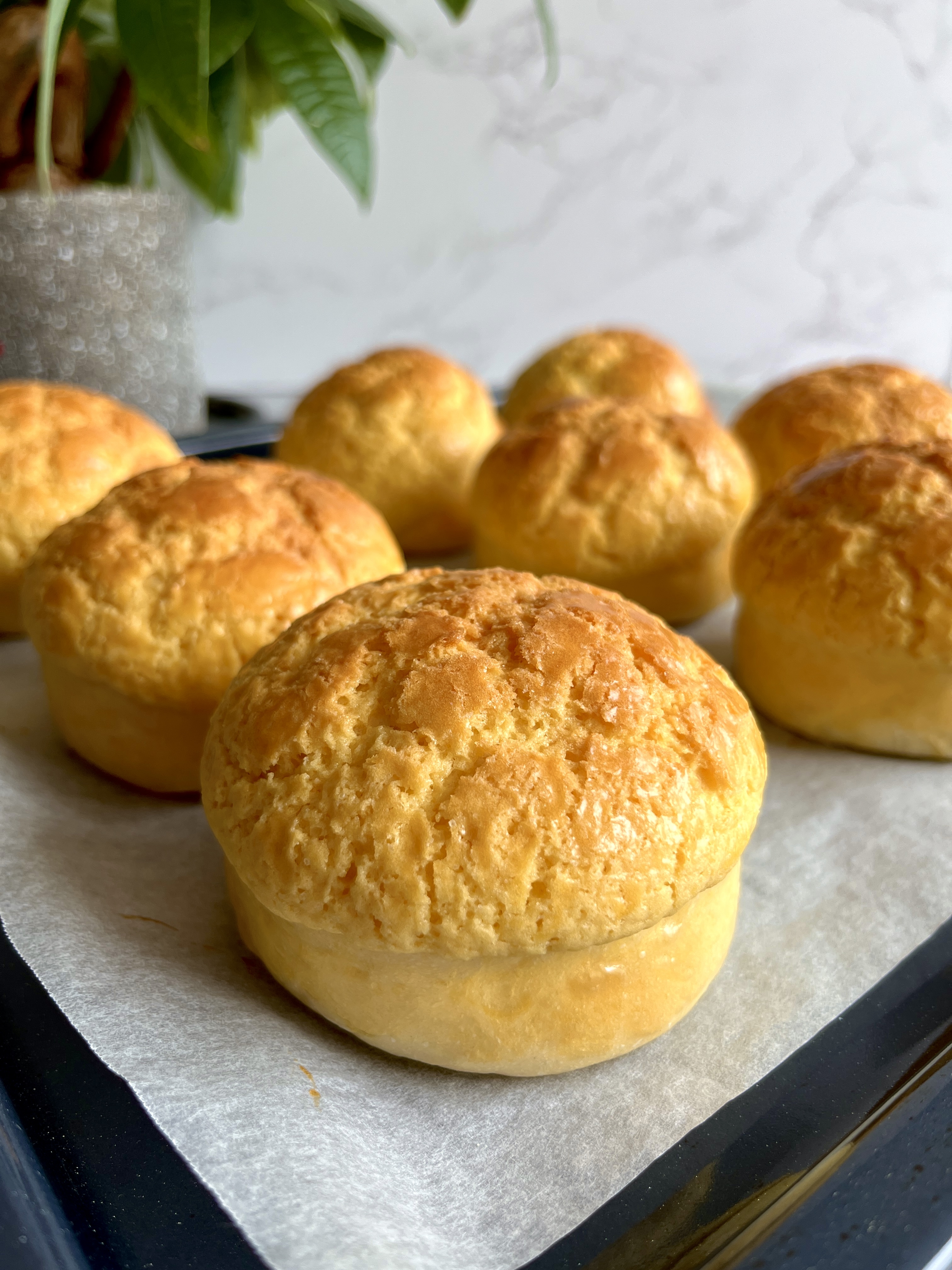
To name a list of iconic Hong Kong style buns, it’s not complete without the signature pineapple bun or Bo Luo Bao (菠蘿包). Found in many Hong Kong cha chaan tengs (or ‘tea restaurants’) and even in Chinatowns across the world, pineapple buns are a type of sweet bread that has a fluffy, bounce-back texture with a golden-yellow, crumbly cookie-like crust on top. Although it’s called a pineapple bun, it doesn’t contain any pineapples at all. Instead, it’s just a typical sweet bun made with flour, eggs, sugar, milk and yeast.
This recipe contains 3 parts – to make the Tangzhong (湯種), the sugar crust on top, and the bread dough. Using Tangzhong to make the bread, it produces a bun that is incredibly soft and chewy on the inside with a delightfully crisp exterior, making it so irresistible and delicious! Spread the bun with some butter to enjoy an extra buttery, savoury goodness.

Table of contents
- Ingredients for Hong Kong style pineapple buns
- How to make Tangzhong
- How to make Hong Kong style pineapple buns (Tangzhong method)
- Success tips for making Hong Kong style pineapple buns
- What is a windowpane test and why should I do it?
- How to do a windowpane test?
- How to know if the dough has properly proofed?
- Other bread recipes
Ingredients for Hong Kong style pineapple buns
For the Tangzhong (or Utane dough):
- Bread flour and water: To make Tangzhong, you’ll need a ratio of 1:5 ratio of flour to water.

For the bun crust:
- Cake flour: Using cake flour will achieve a flaky, crumbly and light texture for the cookie-like crust.
- Baking powder: This adds carbon dioxide to the batter, allowing the crust to spread out and puff out while baking, resulting in a crackly top.
- Butter and sugar: By creaming together the butter and sugar, this enhances the flavour of the crust and yield a crumbly, flaky texture.
- Eggs: Eggs help holding the ingredients of the batter together when baking. Be sure to beat the eggs before adding them into the batter to incorporate the ingredients better.
- Custard powder: Adding this ingredient is optional but it adds a sweet aroma of the crust and makes it more flavourful.

For the bread dough:
- Bread flour: This produces a bread that has a chewy, springy, and fluffy texture.
- Sugar: activates the yeast to help aerate the dough and contributes to the sweetness of the bread.
- Salt: It enhances the flavour and structure of the dough.
- Instant dry yeast: The key leavening agent that allows the dough to puff up during fermentation.
- Milk: Milk adds extra notes of sweetness and milkiness to the buns and also creates a softer bun with a nicely caramelised crust.
- Eggs: help weaken the gluten formation to yield a softer dough and a more springy bread crumb.
- Tangzhong: the secret ingredient to making a fluffy, pillowy-soft bread!
- Unsalted butter: gives a buttery flavour to the bread and tenderises the bread dough to yield a soft and fluffy crumb.

How to make Tangzhong
- In a pot, add in bread flour and water (1:5 ratio). Whisk to combine.
- Over medium-low heat, keep stirring the mixture until it thickens.
- Transfer the Tangzhong to a bowl, then cover it with cling film. Make sure the cling film is wrapped tightly on the Tangzhong’s surface. Set aside and let cool in the refrigerator.


Check out what Tangzhong is and how to calculate Tangzhong in my recent Hokkaido milk bread (Tangzhong method) recipe!
How to make Hong Kong style pineapple buns (Tangzhong method)
Prepare the bun crust
- In a mixer bowl, whisk the butter and sugar until light and fluffy.
- Add in beaten egg mixture and mix to combine.
- Add in baking powder, cake flour, and custard powder. Combine well.
- Roll the cookie dough into a rectangular shape and wrap it with cling film. Chill the dough in the fridge for later use.
Prepare the bread dough
- Combine all the ingredients including Tangzhong in a mixer bowl, leaving the butter for later use.
- Using a dough hook, knead the dough in the kitchen machine for around 5 minutes.
- When the dough begins to form a ball, do a windowpane test (see how-to below).
- Add in butter, then continue kneading for 10 minutes. Do a windowpane test again (see how-to below).
- Shape the dough into a ball and proof it for 1 hour (or until it doubles in size).
- Pat the dough to release air bubbles.
- Divide into 9 equal pieces, then shape each piece into a ball. Proof the buns for the second time (about 1 hour).
- When the 2nd fermentation is nearly done, take out the cookie dough and divide into 9 pieces. Shape each piece into a ball.
- Place each ball piece in between a piece of cling film, then use your palm or a dough scraper to press down on it to make a flat round piece. By placing the balls between cling film, this allows you to easily remove it without sticking onto the work surface.
- After the 2nd proof, gently apply egg wash on the surface of the buns. Place the cookie dough on top of the buns and apply egg wash again.
- Preheat the oven to 180°C.
- Bake for 12-15 minutes until golden brown.


Success tips for making Hong Kong style pineapple buns
Stir constantly when making Tangzhong.
Stir constantly when making Tangzhong on low heat to prevent it from becoming lumpy and sticking to the bottom of the pot.
Cream the butter and sugar to make the bun crust.
This step is key to making the crust spread out when baking to achieve a flakey texture. Whisk them until light and fluffy before adding other ingredients will help incorporate air in the batter, allowing the crust to rise and spread out more while baking. Adding in baking powder will also help with the leavening effect.
What is a windowpane test and why should I do it?
A windowpane test is to verify whether the dough is strong and elastic enough to hold the bubbles as it rises and stretch even more when it is baked in the oven. If the dough doesn’t pass the test, it’s probably under-kneaded so some more kneading would do the work! You could also cover the dough with cling film and let it rest for 15-20 minutes to develop the gluten structure before performing another test.
How to do a windowpane test?
I normally perform the test twice during the kneading process before proofing the dough to ensure the gluten has been well developed. I do a test before adding in butter by pulling out a small piece and stretching it out gently. The dough should be smooth and elastic at this point, and as it tears apart, the holes should have rough edges.
For the second test (performed after kneading the dough with butter added), the dough should be more easily stretched out without breaking. You could use a finger to poke a hole and this time, the hole should be smooth without rough edges. This means the dough is ready to rise!
How to know if the dough has properly proofed?
Dip your finger with some flour and make a dent in the dough. If it bounces back slowly and only halfway, it means that it has fully risen.


Hong Kong style pineapple buns are fluffy and chewy with a sweet, crispy, and flakey crust on top. The combination of multiple textures and their sweet and buttery flavours makes them so irresistible! This is why pineapple buns are a popular choice for breakfast, a side dish for lunch, or a tea-time snack in Hong Kong.
Other bread recipes


Something went wrong. Please refresh the page and/or try again.
I’d love to hear about your experience making my recipes! If you’ve tried this Hong Kong Style Pineapple Buns recipe or any other recipe on HomeCookJournal, then don’t forget to rate the recipe and leave a comment below. Feel free to take snapshots of your experience with my recipes and share them on Instagram so I can repost on stories! And if you have any other foods you’d like to make, please feel free to comment as well!

Hong Kong Style Pineapple Buns
Equipment
- 1 Kitchen machine for the bread dough
- 1 Electronic scale
- 1 Dough scraper
- 1 Rolling Pin
- 1 Mixer bowl for the bun crust
- 1 Silicone baking mat chopping board works well too
Ingredients
For the Tangzhong
- 17 g bread flour
- 85 g water
For the bun crust
- 60 g cake flour
- 1½ g baking powder
- 30 g sugar
- 12-13 g beaten egg mixture
- 30 g unsalted butter
For the bread dough
- 250 g bread flour
- 30 g sugar
- 3 g salt
- 40 g beaten egg misture
- 1 tsp instant dry yeast
- 84 g Tangzhong
- 21 g unsalted butter
- 88 ml milk
For egg wash
- 1 egg
- 1 tbsp water
Instructions
Prepare Tangzhong
- In a small pot, whisk to combine bread flour and water. Heat the mixture over low heat and stir constantly until it thickens.
- Transfer the Tangzhong to a bowl and wrap it with cling film. Make sure the cling film sticks to the surface of Tangzhong to keep its moisture. Chill in the fridge to let cool.
Prepare the bread dough
- In a kitchen machine mixer bowl, add in bread flour, salt, sugar, instant dry yeast, beaten egg mixture, Tangzhong, and milk, leaving the butter for later use.
- Using the dough hook, knead the ingredients on low speed to slowly mix them together. Gradually increase the speed level, and continue to knead until it begins to form a ball (about 5 minutes). Do a windowpane test (see Note 1).
- Add in butter, then continue kneading on medium-high speed for 8-10 minutes. Do another windowpane test to check if the dough is ready to rise (see Note 2).
- Take the dough out and shape it to a ball. Transfer it back to the mixer bowl and cover with cling film or a damped towel.
- Proof for 1 hour or until it doubles in size.
- During the 1st fermentation, prepare the pineapple bun crust.
Prepare the pineapple bun crust
- In a mixer bowl, whisk the butter and sugar until light and fluffy.
- Add in beaten egg mixture and mix to combine.
- Add in cake flour, baking powder, and custard powder. Mix well.
- Use a spatula to scrap out the cookie dough and form it into a rectangular shape. Wrap the dough with cling film and chill it in the fridge.
- After the 1st fermentation, check the bread dough to see if it has fully risen.
- Divide the bread dough into 9 pieces. Shape each piece in a ball, and do the 2nd fermentation (about 45 minutes to 1 hour, or until they double in size).
Assemble the pineapple buns
- When the 2nd fermentation is nearly done, take out the cookie dough from the fridge and divide it into 9 pieces. Shape each piece into a ball.
- Preheat the oven to 180°C.
- After the 2nd proof, gently apply egg wash on the surface of the buns.
- Use a bread scraper or your palm to gently press down on the cookie dough to flatten it.
- Place it on top of each bun, then apply egg wash on the crust.
- Bake the buns in the preheated oven for 15-20 minutes until golden brown.
Notes
- Do a test before adding in butter by pulling out a small piece and stretching it out gently. The dough should be smooth and elastic at this point, and as it tears apart, the holes should have rough edges.
- For the second test, the dough should be more easily stretched out without breaking. You could use a finger to poke a hole and this time, the hole should be smooth without rough edges. This means the dough is ready to rise!