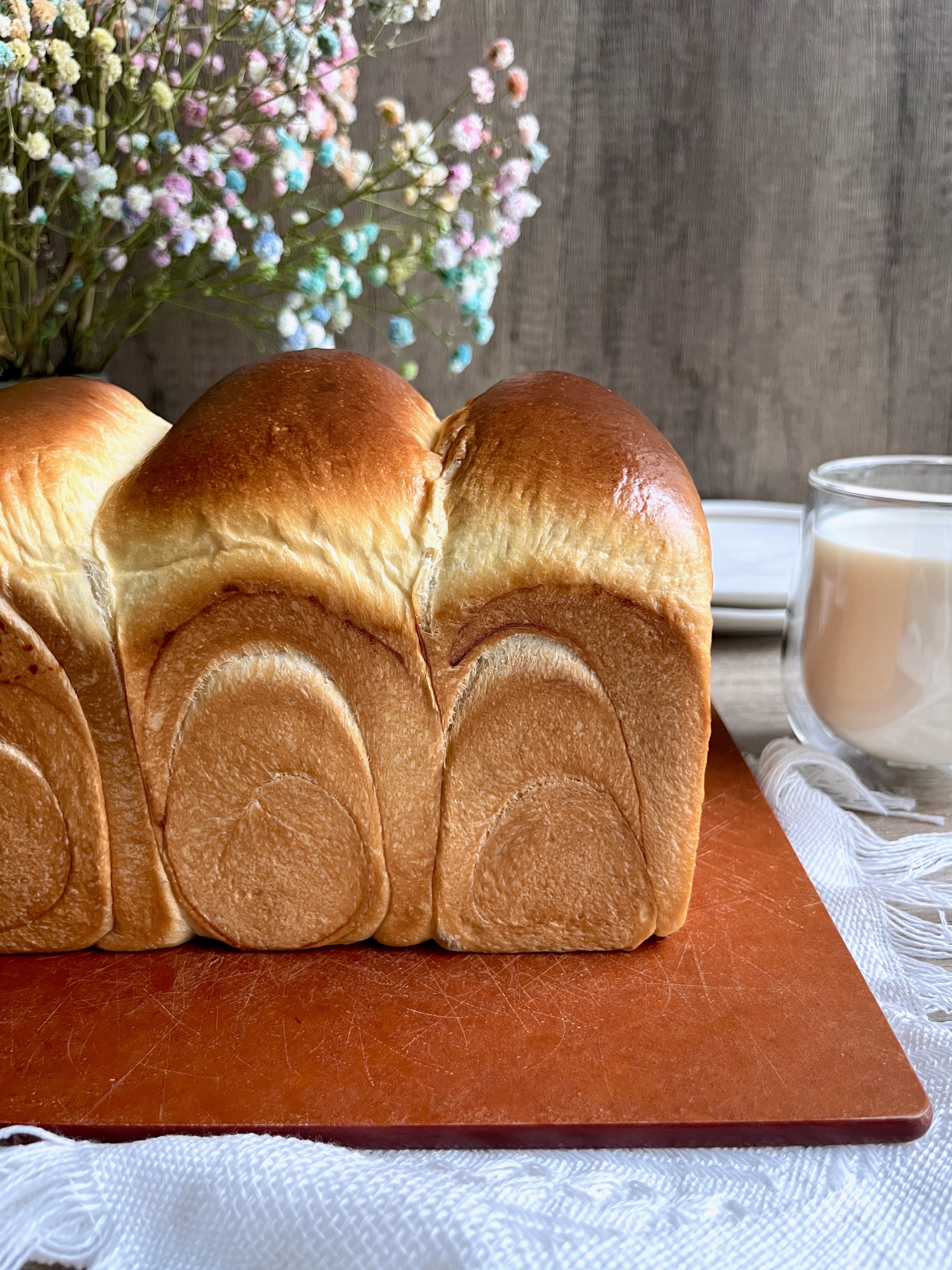
Homemade Hokkaido milk bread is more than just a delicious treat – it’s a nostalgic journey back to the serene beauty and culinary delights of Hokkaido. The first thing that comes to my mind when thinking about Hokkaido will be their fluffy snow in winter. Sipping a cup of hot milk with sugars in it while watching the snow outside, it made me wonder, “how can it be THIS good?” Popular for its creamy, milky, and sweet flavours, Hokkaido milk bread is a type of sweet milk bread originated from Hokkaido, one of the four main islands in Japan.
Enriched with the creamy goodness of Hokkaido milk, this bread evokes the taste of Hokkaido’s renowned dairy products, while its light and airy texture mirrors the fluffy snow that covers the region in winter. The secret to its incredible softness lies in the dough. By incorporating Tangzhong (a water roux starter) with other ingredients for the bread dough, it produces an extra tender and springy bread.
With butter, milk, egg, sugar, and whipping cream, this recipe produces an enriched dough that has a much richer and softer texture, similar to a brioche. Slice up the bread loaf and enjoy on its own or apply any spreads you like for breakfast or tea!
Table of contents
- What is Tangzhong and why should I make it?
- How to calculate the amount of Tangzhong I need for a bread recipe?
- How to make Tangzhong
- Ingredients for Hokkaido milk bread
- How to make Hokkaido milk bread
- How to store Tangzhong?
- How long will the Hokkaido milk bread last at room temperature?
- How to reheat Hokkaido milk bread?
- More bread recipes
What is Tangzhong and why should I make it?
Tangzhong (湯種), also known as a water roux starter or Utane dough is a type of “flour paste” or “water roux starter” that is added to the breadmaking process to produce a soft and fluffy bread. This method is more commonly found in Asian style bread, especially in Taiwan and Japan, where their breads have a pillowy-soft and bouncy texture with a fluffy, stretchy crumb. Originated from Japan, the word ‘tang’ (‘湯’) means hot water. When the flour and water (at a 1:5 ratio) are mixed together and heated to 65°C, the gluten in the flour absorbs lots of moisture from the water, allowing the bread dough to rise and puff up more to produce a soft and springy bread. By adding Tangzhong to other ingredients of the bread dough, it also allows the bread to stay soft for longer.

How to calculate the amount of Tangzhong I need for a bread recipe?
To know how much Tangzhong you need for a bread recipe, simply multiply the sum of flour and liquid in the original recipe by 20%. Using the classic white bread recipe, the amount of Tangzhong you need should you convert it to Tangzhong method would be:
[350g (bread flour) + 260g (milk)] x 20% = 122g (~120g Tangzhong)
Note: for the classic white bread recipe, I used 200g milk and 60g yogurt as I substituted some part of the milk with yogurt to make it softer. Taking that portion into account, the amount of milk would be 260g in this case.
To calculate the amount of flour and water you need to make 120g Tangzhong, divide this by 0.8.
120g ÷ 0.8 = 150g (total weight of bread flour and water)
To make Tangzhong, you’ll need a 1:5 ratio of flour to water. In this example, it would be:
150g ÷ 6 = 25g bread flour
25g x 5 = 125g water
Since you’ll be incorporating Tangzhong with other ingredients of the bread recipe, you’re replacing parts of the bread flour and liquid required in the original recipe, so you’ll need to subtract them for the recipe using Tangzhong method.
350g (original amount) – 25g (bread flour required for Tangzhong) = 325g bread flour
260g (original amount) – 125g (water required for Tangzhong) = 135g milk
Once you have these calculations, you can then make a bread using Tangzhong method using the same steps and the same amount of other ingredients for the bread dough.
Please note that the above is a rough calculation of Tangzhong. You may find Tangzhong bread recipes out there where the Tangzhong represents 20-30% of the sum of flour and liquid, but if it’s over 30%, your dough will become very sticky, making it hard to knead and shape the dough.
How to make Tangzhong
- In a pot, add in bread flour and water (1:5 ratio). Whisk to combine.
- Over medium-low heat, keep stirring the mixture until it thickens with a smooth texture and no lumps.
- Transfer the Tangzhong to a bowl, then cover it with cling film. Make sure the cling film is wrapped tightly on the Tangzhong. Set aside and let cool in the refrigerator.


Ingredients for Hokkaido milk bread
- Bread flour: This gives the bread a chewy and springy texture.
- Yeast: It aerates the bread dough to achieve a light and airy texture.
- Salt: Salt enhances the flavours of all ingredients of the bread and strengthens the dough structure.
- Sugar: This adds sweetness to the bread and feeds the yeast to help aerate the dough.
- Milk: Milk contributes to the sweetness of the bread and yields a softer crumb.
- Whipping cream: Adds richness and softness to the dough.
- Egg: It improves the flavour and texture of the bread, and helps with caramelising the crust.
- Unsalted butter: This adds a buttery flavour to the bread and tenderises the bread dough to yield a spongy and fluffy crumb.
- Tangzhong: A water roux starter that is like a flour paste that gives the bread an extra softness and fluffiness. It is made up of flour and water in a 1:5 ratio.

How to make Hokkaido milk bread
- Prepare Tangzhong in advance.
- Combine Tangzhong with all other ingredients in a mixer bowl, except the butter.
- Using a dough hook, knead the dough in the kitchen machine until the dough begins to form a ball (about 5 minutes). Do a windowpane test (learn how to do a windowpane test here).
- Add in butter, then continue kneading for 10 minutes. Do a windowpane test again.
- Shape the dough into a ball and proof it for 1 hour (or until it doubles in size).
- Sprinkle some flour on the dough and pat to release air bubbles.
- Divide the dough into 3 pieces. Shape each piece into a ball then let them rest for 15 minutes.
- Roll each piece into a rectangular shape, then fold in the long sides to the centre. Flatten it with a rolling pin.
- From the top short end, roll up the dough. Use your fingers to flatten the other short end to seal the ends better.
- Place the dough pieces in a loaf pan of 20cm x 11cm x 11 cm. Proof for the 2nd time until they double in size (about 1 hour).
- Preheat the oven to 180°C.
- Brush the loaf with egg wash and bake for 25-30 minutes in the oven.


How to store Tangzhong?
You can always make a bigger batch of Tangzhong in one go so that you can save time making it again for the next bread using Tangzhong method. Be sure to wrap any remaining Tangzhong with the cling film touching the top surface of Tangzhong. It can be stored in the refrigerator for 3-5 days.
How long will the Hokkaido milk bread last at room temperature?
With Tangzhong, the bread will stay soft and bouncy for longer days at room temperature, around 4-5 days. You can also chill the bread in the refrigerator. This will last for another 5 days.
How to reheat Hokkaido milk bread?
This bread will still be deliciously soft on the first few days, but I always love to slice up the bread loaf and toast it to get a crisp exterior while enjoying the soft and tender crumb inside! You can also air fry it for 2-3 minutes at 180°C or simply pop it in the microwave and reheat for 10 seconds.

This Hokkaido milk bread has an incredibly soft and tender crumb with bursts of milky and creamy goodness! Using Tangzhong method, this yields a bread loaf that is much fluffier and remains soft for longer days. Give this recipe a try and I’m sure you’ll fall in love with this milk bread.
More bread recipes


I’d love to hear about your experience making my recipes! If you’ve tried this Hokkaido Milk Bread recipe or any other recipe on HomeCookJournal, then don’t forget to rate the recipe and leave a comment below. Feel free to take snapshots of your experience with my recipes and share them on Instagram so I can repost on stories! And if you have any other foods you’d like to make, please feel free to comment as well!

Hokkaido Milk Bread
Equipment
- 1 Kitchen machine
- 1 Rolling Pin
- 1 bread loaf pan (L20cm x W11cm x H11cm)
Ingredients
For the Tangzhong
- 19 g bread flour
- 95 g water
For the bread dough
- 300 g bread flour
- 36 g sugar
- 1 tsp salt
- 1 heap tsp instant dry yeast (about 6g)
- 1 tbsp milk powder
- 1 egg beaten (58g)
- 36 ml whipping cream
- 36 ml milk
- 90 g Tangzhong
- 28 g unsalted butter
Instructions
Make Tangzhong in advance
- In a pot, mix together flour and water at a 1:5 ratio.
- Heat the pot over medium-low heat. Stir constantly until the mixture thickens with a smooth texture.
- Transfer Tangzhong to a bowl and wrap with cling film. Ensure the cling film sticks to the top surface of Tangzhong to maintain its moisture.
- Let cool in the fridge for 10 minutes.
Make the bread dough
- In a mixer bowl, add in Tangzhong and other ingredients for the bread dough, leaving unsalted butter for later use.
- Using the dough hook, knead the dough on low speed then gradually increase the speed. Knead until the dough forms a ball (about 5 minutes). Do a windowpane test (see Note 1).
- Add in unsalted butter. Continue kneading for 10 minutes.
- Do another windowpane test to see if it's ready to rise (see Note 2).
- Shape the dough into a ball and cover the mixer bowl with cling film or a damp cloth.
- Proof at room temperature until it doubles in size (about 1 hour).
Make the bread loaf
- Divide the dough into 3 equal pieces and shape each piece into a ball. Cover with cling film or damp cloth, rest for 15 minutes.
- Working on one piece at a time, use a rolling pin to flatten the dough and roll into a rectangular shape.
- Fold both long sides to the centre, then roll up the dough towards yourself.
- Pinch to seal the ends.
- Repeat for the other pieces.
- Place the dough pieces into a loaf pan, leaving some space between each piece.
- Proof for the 2nd time at room temperature until the dough pieces rise to about 70% height of the loaf pan (about 1-1.5 hours).
- Preheat the oven to 180°C.
- Gently brush the loafs with egg wash.
- Bake at 180°C for 25-30 minutes.
Notes
- Do a test before adding in butter by pulling out a small piece and stretching it out gently. The dough should be smooth and elastic at this point, and as it tears apart, the holes should have rough edges.
- For the second test, the dough should be more easily stretched out without breaking. You could use a finger to poke a hole and this time, the hole should be smooth without rough edges. This means the dough is ready to rise!