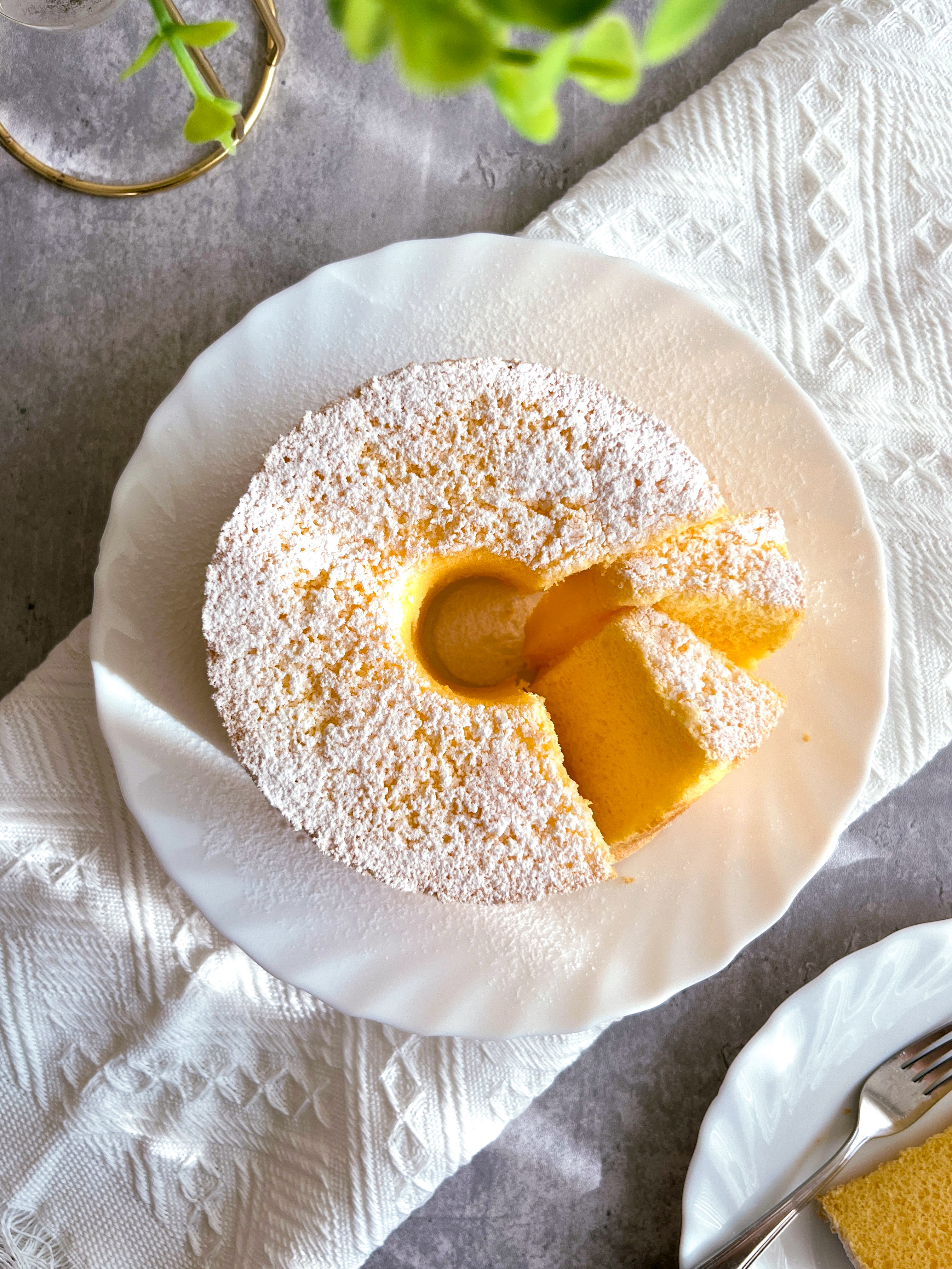
This basic chiffon cake proves that a simple, classic flavour gives you a delicate cake with a subtle sweetness to it. Its airiness and pillowy-softness makes this chiffon cake my all-time favourite! Complete with dusting powdered sugar over the top, I’m sure you’ll be having one piece after another.
I’ve had many failed attempts on making chiffon cakes in the past where the cake shrinks and sinks in the middle after baking. After trial-and-errors, I realise the secret to making a successful chiffon cake lies in the beating of egg whites, as they are the key ingredients that allow the cake to rise. You have to whisk them until stiff peaks and stop from there. Otherwise, you’ll overbeat the egg whites.
Table of contents
Ingredients for 6-inch chiffon cake
- Cake flour: Using cake flour is key to producing the light, airy and fluffy texture.
- Oil: Oil contributes to the tenderness of the crumb, yielding a light, soft, and airy texture.
- Milk: This adds moisture to the cake to create a softer crumb, preventing the baked cake from becoming too dry and crumbly.
- Eggs: Separate egg yolks from egg whites to make chiffon cake. The egg yolks add moisture and richness to the cake, while the egg whites (whipped) act as a leavening agent that aerates the batter.
- Sugar: Leave ⅓ of the sugar for the flour batter while the rest is used for beating the egg whites. This is key to forming foamy meringue (beaten egg whites) that stabilises it after beating.
How to make basic 6-inch chiffon cake
- Separate egg yolk and egg whites. Keep the egg whites chilled in the fridge.
- Preheat the oven to 150°C.
- In a large mixer bowl, add in oil and milk. Whisk to combine.


- Sift in cake flour and mix well.
- Add in egg yolks and sugar. Mix well.


- In another mixer bowl, beat the egg whites, adding in sugar 3 separate times. To make a perfect meringue (beaten egg whites) for the chiffon cake, see tips below.


- Add ⅓ of the meringue into the batter and stir to combine. Gently fold the mixture into the meringue.


- Pour the batter into a 6-inch chiffon cake pan. Stir with a toothpick or a baking needle and tap the pan against the kitchen table several times to remove air pockets.


- Bake in the oven for 50-55 minutes.
- When it’s baked, let the cake pan cool upside down before unmolding.
- Dust icing powder on top (optional).


Success tips for making a perfect chiffon cake
Use the correct chiffon cake pan.
Be sure to use an aluminium chiffon cake pan where the bottom is separable. Do not use a non-stick pan to make chiffon cake as the batter needs to cling to the sides and centre of the cake pan for it to rise.
Do not skip sifting in the cake flour.
Chiffon cake recipe requires fine crumbs so that it can rely on the beaten eggs to lift. By sifting in cake flour, this eliminates the risk of creating crumbs in the batter and allows the ingredients to be mixed quicker and easier without knocking out the air out of the beaten eggs.
Make a perfect meringue (see how-to below).
This is the most important step in the chiffon cake recipe. With a perfect meringue, the air created from beating the egg whites can be held stable, allowing the batter to rise tall during baking and result in a light and airy texture. If it’s under whipped or over whipped, it will cause the cake to collapse. See tips below to make a perfect meringue.

Fold in a cutting motion.
When folding the flour mixture into the meringue, do not stir to combine. Instead, fold in a cutting motion to prevent deflating the egg whites.
Do not over mix the batter.
Over mixing the batter will develop too much gluten in the batter, resulting in a tough, dense and dry cake.
Remove air pockets before baking.
Before baking, use a toothpick or baking needle to swirl on the surface of the batter, and tap the cake pan against the table to remove large air bubbles. This prevents the baked chiffon cake from having large holes inside and will ensure a more even and finer crumb.
Let cool upside down.
When the cake is baked, take it out from the oven and let it cool upside down. This prevents the chiffon cake from shrinking due to air pressure. Unmold the cake only after the cake pan is completely cooled down.

Success tips for making a perfect meringue
Use chilled egg whites.
This recipe doesn’t require adding in acid (eg. lemon juice or cream of tartar) to the egg whites to make the meringue. With chilled egg whites, you can make a smooth meringue that is strong enough to hold the air bubbles, allowing the batter to rise higher and fluffier during the baking process.
Beat egg whites until stiff peaks with a tip that slightly folds over.
To make the perfect meringue, divide the sugar and add in 3 separate times while beating the egg whites. Begin with beating the egg whites on low speed using a hand mixer. When it forms a pale colour foam with large air bubbles, add in ⅓ of sugar.


Increase the speed to medium-low and beat until the egg white foam increases in volume with smaller air bubbles. Add in another ⅓ of sugar.


Continue beating on medium speed until you see a thickening texture, then add in the remaining ⅓ of sugar.


Beat gently on low speed to make a smoother meringue. The peaks formed by the egg whites should stand straight up without collapsing or drooping. This means the meringue as formed stiff peaks, and is ready to mix with the batter!

Can I substitute oil with butter?
No, you cannot use butter to make chiffon cakes. The reason why chiffon cake recipes call for oil instead of butter is because oil wraps around the flour and contributes to the tenderness of the crumb, yielding a light and airy texture.
What’s the difference between chiffon cake and sponge cake?
Both chiffon cakes and sponge cakes have similar textures – they are soft and moist, and both cakes are primarily lifted by beating egg whites to make a meringue. Some chiffon cake recipes would even include baking powder as a backup to ensure the cake will rise tall enough. But the main difference between the two cakes is that chiffon cake recipes will always use oil to achieve that fluffy, airy and soft texture, while sponge cake recipes could use either butter or oil, although I do prefer using oil in sponge cake recipes to achieve a lighter texture!
More dessert recipes


I’d love to hear about your experience making my recipes! If you’ve tried this Basic 6-inch Chiffon Cake recipe or any other recipe on HomeCookJournal, then don’t forget to rate the recipe and leave a comment below. Feel free to take snapshots of your experience with my recipes and share them on Instagram so I can repost on stories! And if you have any other foods you’d like to make, please feel free to comment as well!
Save this recipe!
Get this sent to your inbox, plus get updates on any new recipes!

Basic 6-inch Chiffon Cake
Equipment
- 2 Mixer bowls
- 1 Spatula
Ingredients
- 3 egg yolks
- 3 egg whites
- 35 ml oil
- 40 ml milk
- 50 g cake flour
- 45 g sugar (15g for egg yolk + 30g for egg white)
Instructions
- Separate egg yolks and whites. Set aside. Keep the egg whites chilled in the fridge.
- Preheat the oven to 150°C.
- In a mixer bowl, add in oil and milk, whisk to combine. Sift in cake flour. Combine well.
- Add in egg yolks and 15g sugar. Mix well.
- In another mixer bowl, beat the egg whites to make a meringue, adding in sugar in 3 separate times. Beat until stiff peak forms.
- Add ⅓ of the meringue into the egg yolk mixture, then whisk to combine. Gently fold this mixture into the remaining meringue.
- Pour the batter into a 6-inch chiffon cake pan, then stir with a tooth pick or a baking needle, and tap the cake pan against the table to remove air bubbles.
- Bake in the oven at 150°C for 50-55 minutes.
- When it’s baked, take out the pan from the oven and let cool upside down. Unmold when the cake is completely cooled down.